STRIDE-CAP Pilot Study Establishing the Framework for a Pneumococcal Vaccine Test-Negative Design Case Control Study
The STRIDE-CAP Pilot Study was conducted at 13 sites in 4 European countries.
This pilot was designed to validate the infrastructure and methodology for the subsequent Test-Negative Design (TND) Case-Control Study to evaluate the effectiveness of a new adult pneumococcal vaccine.
The pneumococcal polysaccharide conjugate vaccine (21-valent) has been licensed in several countries under the trade name CAPVAXIVETM.
Objectives
- Vaccine history data source assessment: Evaluating data completeness by rigorously reviewing site-specific records to assess accurate immunisation tracking.
- Clinical data integrity: Assessing the depth and completeness of medical histories and key covariates sourced from Electronic Medical Records (EMR) and hospital admission data.
- End-to-end operational testing: Conducting a comprehensive "dry-run" of all study processes - from initial sample collection and laboratory handling to imaging retrieval.
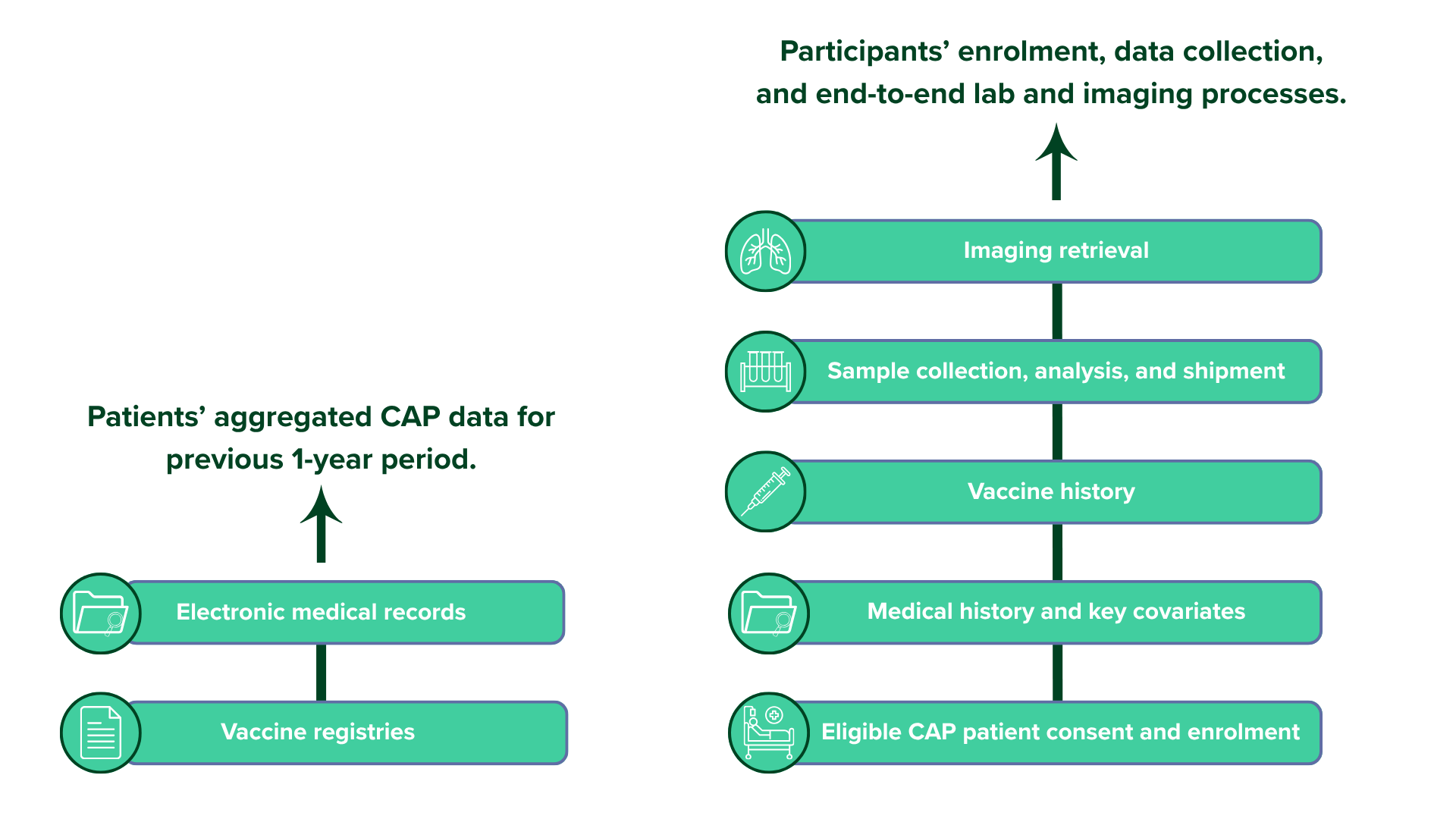
Figure 1: Study Procedures
Study Setting / Site Selection
The pilot was conducted in a real-world setting. In Europe, 38 hospital sites in 4 countries were invited to participate and 21 hospital sites were ultimately selected: Germany (6), Netherlands (4), Spain (6), and Italy (5).
Of these, 18 were finally activated and 13 contributed to data collection and end-to-end processes:
- Germany: Berlin, Dortmund, Hannover, and Jena
- Netherlands: Amersfoort, Nijmegen, and Roermond
- Spain: Cordoba, Madrid, Seville, Valencia, and Zaragoza
- Italy: Bari
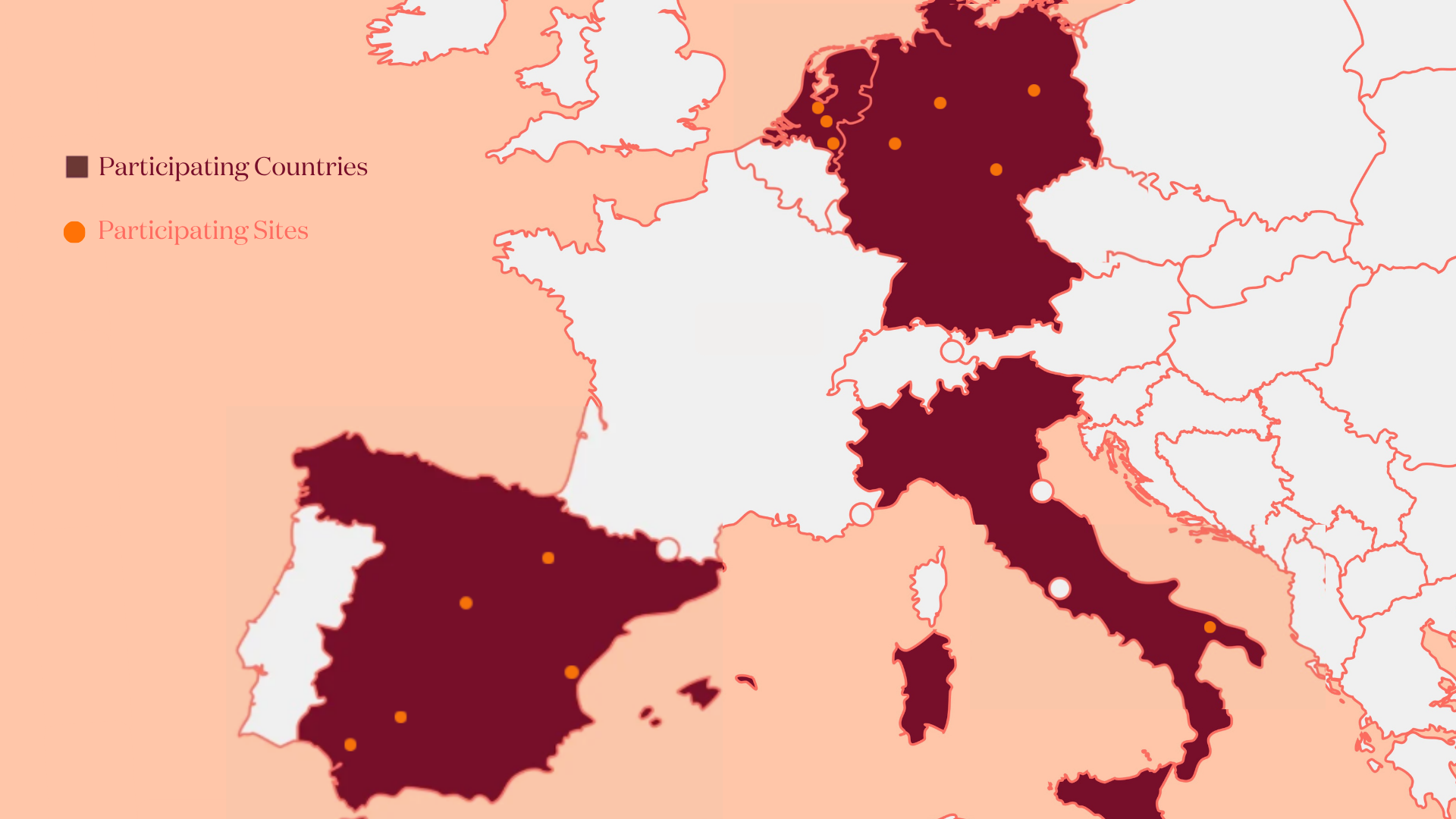
Figure 2: Map of Participating Sites per Country
Key Results
Aggregated CAP patient data in the prior 1-year period: Sites were able to report the historical counts of patients hospitalised in the prior 12-month period with an ICD-code indicating pneumonia from the primary source of Electronic Medical Records (EMR). Higher frequencies of hospitalisations were observed among patients aged 75 years and older.
Completeness of Key Data
Enrolled participants:
- 86 (29 Germany, 3 Italy, 15 Netherlands and 39 Spain).
- Mean age 77.6 and 60% male.
- 47.4% of participants had at least one underlying condition or risk factor reported.
- Requested key clinical variables from medical history and detail of hospital stay were available and complete for almost 100% of pilot participants.
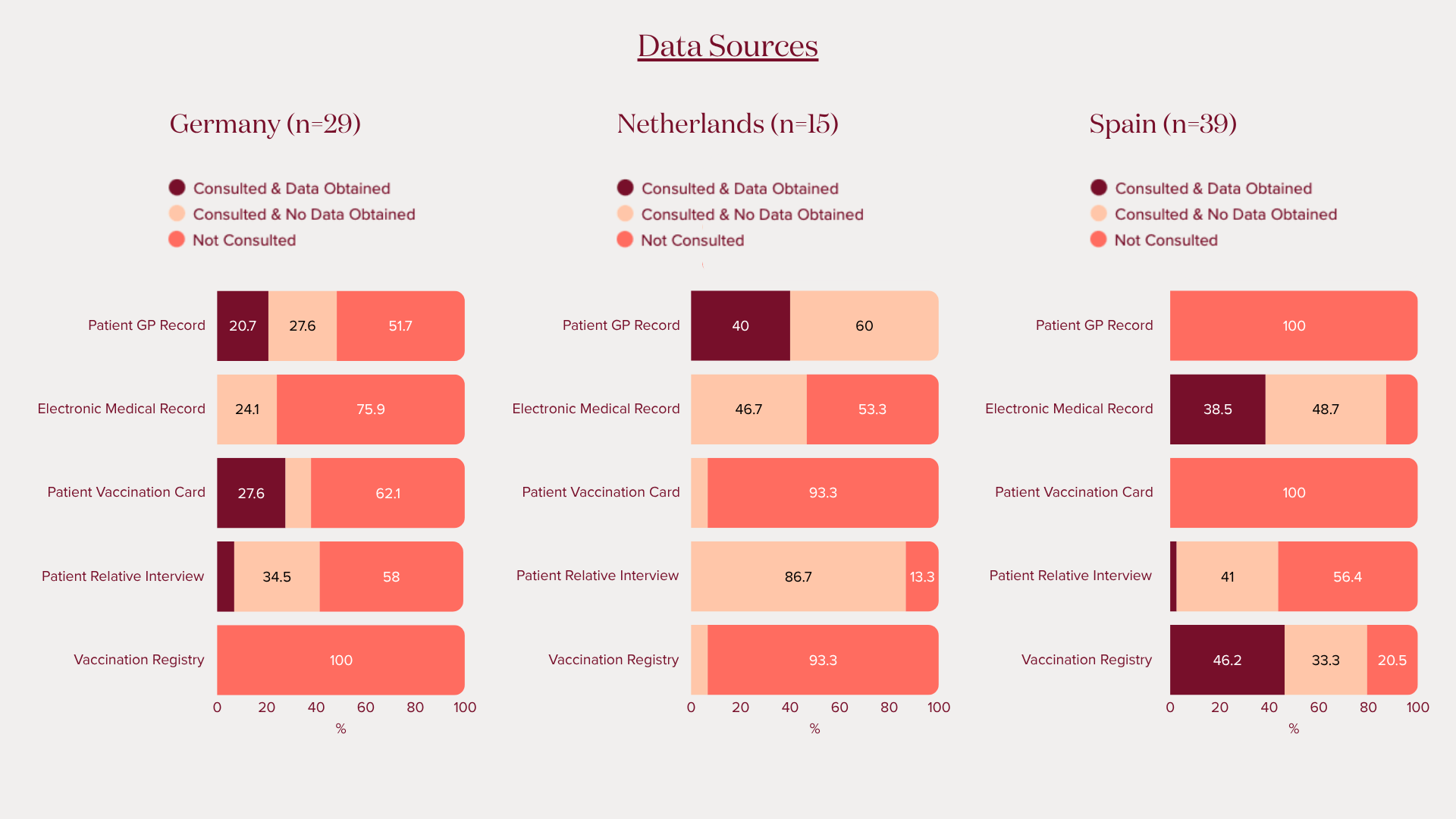
Figure 3: Pneumococcal Vaccination Data: A positive record of pneumococcal vaccination data was obtained in 50% of pilot participants (48.3% Germany, 40.0% Netherlands, 64.1% Spain , and 33.0% Italy). Figure 3 shows how often each data source was consulted in each country (excluding Italy due to n=3), distinguishing, for each source, whether the requested data were successfully obtained or not.
Other respiratory vaccines history as negative control exposures in full effectiveness study:
- Data related to COVID-19 and Influenza vaccines was obtained for more than 80% of the pilot participants.
- Respiratory Syncytial Virus (RSV) vaccine history was only obtained for participants in Germany.
National uptake estimates were also consulted on benchmarked sources, such as public health report and/or peer-reviewed literature. The results were aligned with the findings on the pilot.
Assessment of end-to-end processes:
- Both urine and blood were fully obtained in nearly 100% of participants.
- Clinical samples positive for S pneumoniae on culture as well as clinical discard aliquots were processed and shipped successfully per-protocol.
- Urine was aliquoted as directed for the majority of participants and samples were shipped for all participants with urine collected.
- BinaxNOW testing was completed on urine from all participants who provided a urine specimen,
- Imaging was submitted for all participants and was primarily comprised of chest X-rays. All protected health information was successfully redacted.
Conclusion
The STRIDE-CAP Pilot Study has provided essential proof-of-concept for the upcoming 21-valent pneumococcal test negative case control study (the STRIDE-CAP Full Study).
Key conclusions include:
- The scientific and operational protocols for the full study were successfully implemented across 13 sites in Europe.
- Electronic Medical Records (EMR) and vaccination registries were confirmed as the most reliable and frequently utilised data sources, providing high-quality inputs for the study.
- The proportion of participants with pneumococcal vaccination history obtained aligned well with national uptake estimates, validating the recruitment and data-capture methodologies.
- Vaccination history for other vaccines that may serve as negative control exposures were consistent across the most common data sources consulted.
- Specimen collection, processing and shipping, and imaging transfer were completed successfully for the majority of participants, ensuring the feasibility of the end-to-end study workflow.
With the successful completion of this pilot, we have established the feasibility for conducting a high-quality case-control vaccine effectiveness study. Start-up activities are now underway for the STRIDE-CAP Full Study, which will leverage these validated processes to evaluate the real-world effectiveness of the 21-valent pneumococcal conjugate vaccine.